|
|
|
|
|
|
A
meeting room on the first floor situated between the central front
columns.
|
|
|
|
|
|
|
|
|
|
A
view south from the balcony of the meeting room in the previous
photo at 390 feet (120m) above sea level. In the foreground is Paulsgrove
and the M27. Centre ground left is Port Solent and right
Portchester Castle. Beyond this on the left is Portsmouth and on
the right Gosport. Beyond that lies the Solent and finally the
Isle of Wight.
|
|
|
|
|
|
|
|
|
|
There
was a rumour that there were three levels of basement below this
building. There is in fact one, and it occupies a quarter of the
buildings floor area on the western side. It was used for document
storage.
|
|
|
|
|
|
|
|
|
|
The
strong room for secure storage.
|
|
|
|
|
|
|
|
|
|
This
emergency escape tunnel leads outside the building via the ladder
to an escape hatch on the lawn.
|
|
|
|
|
|
|
|
|
|
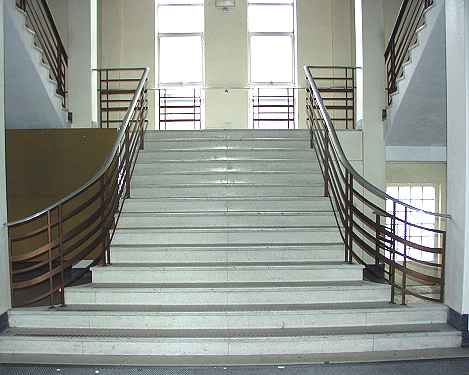
A
view eastwards of the central quadrangle or courtyard. The 'art
deco' style prevails here as well. The front stairwell is on the
right. Two buildings were added here with the one in mid-ground
still remaining.
|
|
|
|
|
|
|
|
|
|
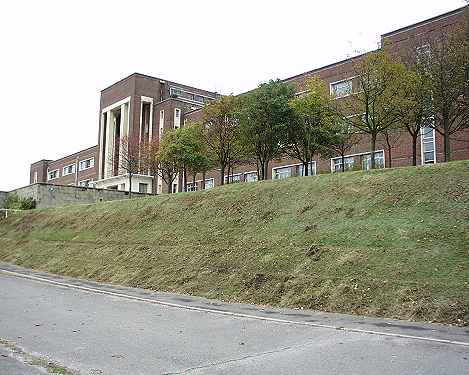
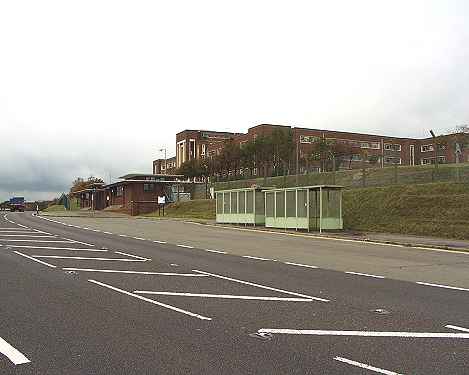
At
the back of the main building are the workshops and other support
buildings still with the distinctive architectural style. The
whole site has a feel of 'post nuclear Britain' about it.
|
|
|
|
|
|
|
|
|
|
Looking
west at the ramparts of neighbouring Fort Southwick.
|
|
| |
|
|
|
|
Here are
some extracts from emails received about Portsdown Main. The italicised comments in [] brackets are mine.
|
|
|
|
NEW - 02-01-2010 |
|
|
I wondered if anyone knew my father who worked at ASWE, probably between
1960-1970. His name was Raymond Henry Cook. He died in 1971 on holiday in
Cornwall. He was born in 1919. As a young child I can remember clearly
going to a Christmas party in the art deco building.
As my parents were divorced, I never knew my father's true occupation,
except that he had been a CPO in the Navy during the WW2 and was very
clever.
If anyone has any information or access to staff information it would be
gratefully received. Many thanks.
Diane Townsend - January 2010 (reply
here) |
|
|
|
|
|
NEW - 01-02-2009 |
|
|
Hi, my father Charles Holbourn used to work at ASWE in the 1960s,
something to do with guided weapons. He was there for quite a few years
and before that he was at Portland, Dorset. I just wandered if any one
might have worked with him?
Paula
Ellinor - February 2009 |
|
|
|
|
|
| |
NEW - 01-02-2009 |
|
| |
I came across your site when I Googled ASWE, as I was an apprentice there
from 1976 to 1980. It is so sad to see this site with its buildings all
going to rack and ruin. A few years ago I went to a machinery auction
there. I was so looking forward to going to see where I once trained, but
I was in for one hell of a shock. To see what was once a thriving
'community' was obviously now in terminal decline. I know its a rapidly
changing world, and maybe the site really is no longer required by the
MoD, but it still seems so sad if not criminal to let it all go to rack
and ruin.
I have lived in this area since 1964. From 1964 to 1978 I lived in
Beverley Grove, just east of Farlington Redoubt.
I also became fascinated with tunnels. This fascination started when the
admiralty moved out of
Fort
Purbrook and the whole place was left open for anyone to explore! I
was also very interested in the rumours that there might be tunnels that
either extend out from the forts or possibly even link the forts together.
I distinctly remember the two large underground rooms at the bottom of the
main spiral staircase, and the narrow walkway that extended around these
two rooms. I also distinctly remember searching for hidden tunnel
entrances, that may lead away from the fort, but other than a narrow
passage into the chalk, which extended approx only a few yards and then
narrowed to a dead end, nothing was ever found.
At the time I put my best hope in there being a water tunnel, as somewhere
in the middle of the fort was a (highly dangerous) open manhole that led
to an underground room containing water. If my memory serves me well, this
underground room had tunnels leading off it , but I would have needed a
canoe to explore them further as they too were containing water.You
mention the strange chimney to the east of the fort. This was an eerie
chimney as in foggy conditions the chimney could mysteriously appear (
when there was fog or mist between it and the fort) and disappear in clear
conditions when it visually blended into the fort. I too was suspicious of
this chimney- It HAD to lead to something. One day I noticed that it had
been knocked to the ground, and went to see what could be found.
Unfortunately quite a considerable amount of rubble was blocking the
underground access, far too much even for an inquisitive young lad to
shift unaided!
I also wonder if any evidence of tunnels were discovered when the cutting
was dug/ surely the road level is plenty deep enough for a tunnel in the
Redoubt direction?
Mike O'Hagan - February 2009 |
|
| |
|
|
|
NEW - 01-06-2008 |
|
|
I was fascinated by your website and will try to add my bit as I am
revisiting my childhood more than 50 years later by staying in Pompey ,
with my wife Ingrid.
I was born in 1942 in Birmingham but turned up in Pompey in 1943 with Mum
& Dad living at 11, Rosebery Avenue, Cosham . Dad was Herbert David Gilroy
- he had joined the newly formed MOD Police Service. By 1952 I had 2 more
brothers and we all moved to the two Police Residences up on the Hill when
Dad was promoted to Inspector. I have photos of us outside our home. The
site was then called ASRE -Admiralty Signal and Radar Establishment.
Dad, as Senior Police Officer, was always meeting the top people there -
the Chief Scientist - when transistors were in their infancy. It was a
"technical place ".
Dad was "security " so not much I will reveal in this email - but I do
remember him, firearms and all, going out in the night on an "inspection".
David Gilroy - May 2008 |
|
|
|
| |
| NEW - 07-03-2007 |
|
I had my first job after graduation at ASWE, from October 1975 to October
1977. I actually worked for Ferranti, an on-site contractor (we had two
portakabins!), MoD code XBC3F.
I had a happy two years at ASWE. We used to walk to the canteen at
lunchtimes, getting stunning views of the Solent, for free. MoD police on
site, with dogs. We were often stopped if we'd forgotten to put our ID
badges on. A lay-by thoughtfully provided outside where Russian spies
could park and take photographs of people going into work and their car
registration numbers!
I remember the day I started; the USS Nimitz was anchored out in the
Solent, too big to come into Portsmouth harbour. 91500 tons, a monster of
a ship. Then the Royal Review of the Fleet in 1976. Scores of visiting
warships anchored in the Solent. I went up into the 'radar building'
(which had a radar the size of a single-decker bus permanently rotating
above it). We'd never seen so many 'blips' on the screen. I also remember
the drought of 1976, which spectacularly ended in a thunderstorm at
Portsmouth naval base, when I was there on 'Navy Day'.
I used to work on systems for Type 42 frigates, in particular HMS
Sheffield, later to be destroyed in the Falklands conflict. HMS Bristol
too I think, but she was a 'one off', the MoD switched to the cheaper Type
42s. The same system was to go onto the 'ARA 42s', which were working up
in Portsmouth at the time. 'ARA' was the Armada Republica Argentina, the
ships were later named Hercules and Trinidad Santisima. I think they came
out of port in the Falklands conflict, only to beat a hasty retreat when
the saw the Royal Navy on the horizon! They stayed in port for the rest of
the conflict.
The 'big' radar was the Type 965, two smaller ones fore and aft (under
hemispherical cowlings) were Type 909s. Considered 'old technology' even
back in the 1970s.
I often wondered what happened to ASWE, I guessed it was probably sold to
Qinetic or became part of the DRA, looks like I wasn't far off. Maybe
it'll be sold off for 'executive housing', but I hope not. I did get in
touch with one of my colleagues via Friends Reunited, but I've forgotten
the names of most of the others, it all seems a long time ago now.
Anonymity requested - March 2007
|
|
|
|
| |
|
| |
| NEW - 28-05-2006 |
|
What a joy! Browsing your website brought back many happy memories of my time at ASWE, and answered many questions I'd pondered since first setting foot on the Hill, although I found the pictures of empty rooms rather sad.
I was "posted" to ASWE Portsdown in 1973 and worked there for about 9 months. I'll never forget the scene that presented itself on day one as the "ferry" came over the crest onto Portsdown Hill. The hilltop positively bristled with radar dishes and antennae. That image is permanently burned into my memory!
The "ferry"" was a black saloon car or navy blue Bedford van, running from ASWE Portsdown to Havant station.
After a while I started to notice all those peculiar features in the landscape so well documented in your website. I remember saying to colleagues "What a fascinating place this is". Since then I've spent many happy hours immersed in books on defensive structures,
Napoleonic forts, bunkers and tunnels, so the Hill obviously had an effect on me! By the way, the deputy director of ASWE (in 1980) Dr John Wood, wrote a fine book called "Sun, Moon and Standing Stones" on the subject of megalithic circles.
My digs were on Hayling Island, for which I have vague memories of shark sandwiches and strong beer.
Andrew Taylor - May 2006
|
|
|
|
| |
|
| |
| NEW - 21-10-2004 |
|
I was an apprentice at ASWE in the 70s. One of your photos shows a tiny bit of
the old apprentice training shop. The place doesn't look too bad other than the overgrowth. On the south side of the workshops used to be the
sheetmetal shop a newer structure where I spent most of my time 1973-1978. Although the W in ASWE stood
for weapons the work concentrated mostly on RADAR R&D. The massive main
shop contained some really long lathes used for radar masts. The coppersmiths I worked with would spend hours bending and polishing
waveguides (rectangular metal pipe) which the radar signal would travel
thru.
On one expedition to the dockyard I got to help fit a shield on
HMS Sheffield to prevent exhaust from her stack interfering with the radar installation behind it. Several years later after I had moved to
the USA and the Falklands war was on, I thought about that piece of my
handywork, now forever under the southern Atlantic. Keep up the good work
Paul Emery - October 2004
|
|
|
|
| |
|
| |
| NEW - 20-10-2004 |
|
I lived in Portsmouth for a while - once in the 1980s and again in the 1990s. I used
to work for the MoD and was based at Portsdown Main.
The site changed quite a bit between the two times I was there. Originally
the Engineering buildings had a full metal workshop and I believe a composite materials workshop which supported the research work that ARE
did. In the 90s the engineering shops were vacated as the site stopped its
Research work and essentially became offices for mainly MoD Civilians supporting Defence Procurement more than anything else.
I do remember Security was pretty lax in the 80s. It got better in the 90s.
Friends and I had competitions to see what we could replace the passes with
that you had to show gate security to get into the site. As I recall a slice
of toast and lettuce leaf both worked!
I did come upon a secure area once. I was passing a door in one of the many
other buildings on the site that was very similar to the "strong Room" picture you have and it was opened so I had a look. Inside was a fairly
large office area which was being refurbished. It looked like it was
soundproofed and probably screened against radio. This sort of area would have been used for work on Top Secret Projects - Secret and below was
pretty routine and just about everyone is cleared to Secret as a matter of course.
It was interesting in as much as any area one doesn't know about is interesting, but not really mysterious in any way. Unfortunately I opened
another door whilst inside which led outside the building. It was early evening so few people were around. The door could only be shut by locking
it with a key, and there wasn't one, so I had to go find security and confess
my sins so they could lock the door again.
Mark Nicholson - October 2004
|
|
|
|
| |
| |
|
|
click the
arrow |
|
< |
page
2 of
2 |
|
|
|
|
|